The Fuel Price Problem Is Not Going Away
Anyone filling a tank today knows the feeling. Fuel prices across Europe and globally have been on a volatile ride for years, and the situation is not stabilizing. Ongoing tensions in the Middle East, a region responsible for a significant share of global oil supply, continue to introduce uncertainty into energy markets. Geopolitical events that are far removed from a logistics manager in Warsaw or a fleet operator in Amsterdam can translate directly into a 20% spike at the pump within weeks.
This is not a new story. Oil has always been geopolitically sensitive. But the frequency and scale of disruptions are growing, and businesses and individuals who depend entirely on fossil fuels are increasingly exposed to costs they simply cannot predict or control.
The question is not whether fuel prices will stay high. The question is: how long will you wait before you take back control?
The Honest Case Against EVs, And Why It Is Shrinking
Before making the case for electric vehicles, it is worth being direct about the real objections. They are legitimate.
Upfront cost is higher.
A comparable electric vehicle still costs more to purchase than a combustion equivalent in most segments, particularly for commercial fleets. This is a real barrier, especially for SMEs operating on tight capital budgets.
Charging infrastructure is still uneven.
In dense urban areas and along major European corridors, public charging is increasingly accessible. In rural regions or across certain Eastern European markets, the network remains patchy. Range anxiety, while statistically overstated for most daily use cases, is not irrational in every context.
Grid dependency is a genuine concern.
An EV is only as clean as the electricity that charges it. In grids still heavily reliant on coal, the carbon argument for EVs is weaker than the marketing often suggests.
These objections deserve acknowledgment. But in 2025 and beyond, the trajectory of each of them is moving in one direction: toward resolution.
Battery costs have dropped roughly 90% over the last decade. Charging infrastructure is expanding at a pace that was unthinkable five years ago. And European electricity grids are getting cleaner every year, with renewables now accounting for the majority of new capacity additions.
What EVs Actually Give You: Control Over Your Energy Costs
Here is the core argument, and it is not primarily about the environment, though that matters too.
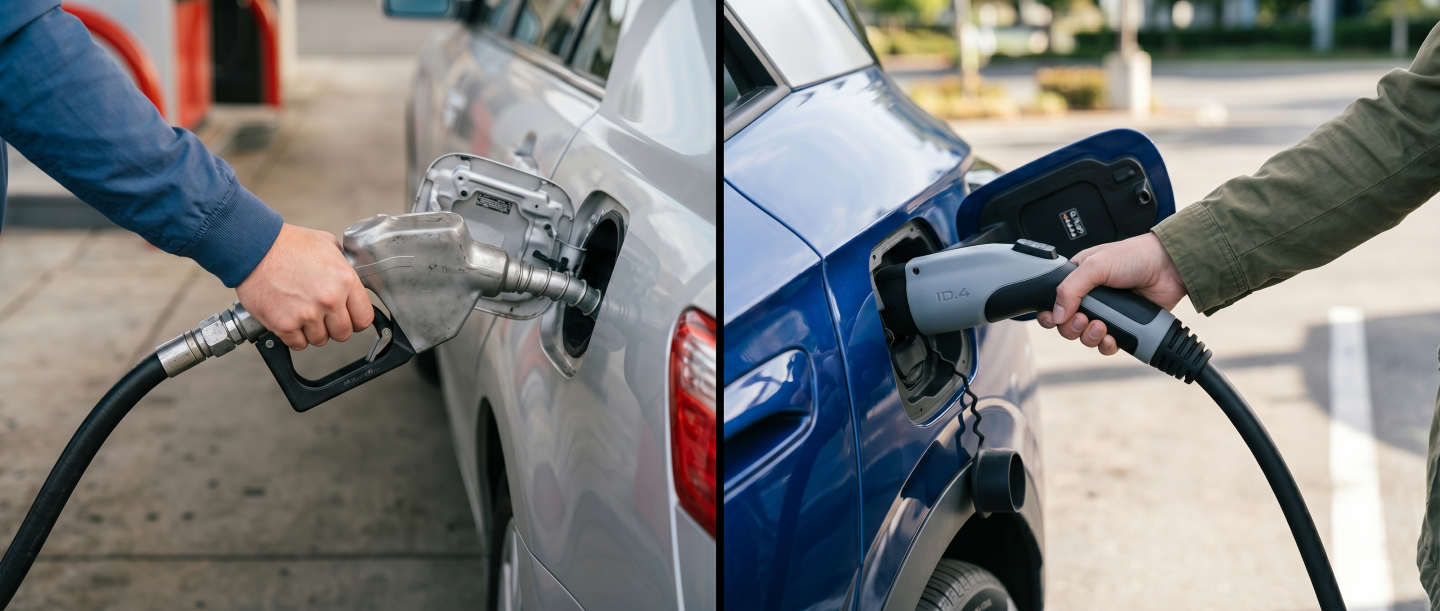
Electric vehicles decouple your transportation cost from the oil market.
When you drive a combustion vehicle, your fuel cost is set in Rotterdam, in Riyadh, and on futures exchanges you have no influence over. You are a price taker. Full stop.
With an electric vehicle, you have options that simply do not exist for petrol or diesel.
Option 1: Charge From Your Own Solar Installation
A business or individual that installs solar panels and charges their EVs on-site is, for a significant portion of their energy use, generating their own fuel. The cost per kWh from a rooftop solar installation in central Europe is now in the range of €0.04 to €0.08 over the asset’s lifetime, compared to €0.20 to €0.35 per kWh from the grid, or the fuel-equivalent cost of petrol.
A fleet of 10 vehicles charged primarily from on-site solar represents a transportation cost that is largely insulated from oil market shocks. You have, in effect, locked in a significant portion of your fuel price for 20 to 25 years.
Option 2: Use Cleaner, More Stable Grid Electricity
Even without solar, EV drivers benefit from electricity markets that are structurally different from oil markets. Electricity prices fluctuate, but they are influenced by a far broader and more diverse set of inputs: wind, solar, hydro, nuclear. They are not tied to a single commodity extracted from a handful of geopolitically unstable regions.
Smart EV charging software like EVLoader allows fleet managers and building operators to schedule charging during off-peak hours when electricity is cheapest, or to respond dynamically to real-time grid pricing. This is a level of cost optimization that is simply not available with fuel.
Option 3: Load Management Across a Fleet
For companies deploying multiple EVs, smart load management is where the economics become compelling at scale. Without load management, simultaneously charging multiple vehicles can spike demand charges, a separate component of commercial electricity bills based on peak consumption, to levels that wipe out the fuel savings.
Intelligent load management software distributes charging load across available capacity, staggers charging sessions, and prioritizes vehicles based on departure schedules. Done well, a company can double or triple the number of EVs it charges on existing electrical infrastructure without expensive grid upgrades.
This is one of the core functions EVLoader was built to solve.
The Fleet Manager’s Perspective
For companies running vehicle fleets (delivery, field service, sales, logistics) the calculus is increasingly clear. Fuel is the second or third largest operating cost after personnel. It is variable, hard to forecast, and subject to disruptions entirely outside your control.
Electric vehicles, paired with the right charging infrastructure and software, shift that cost into a more manageable category. You can model it, schedule it, and in part generate it yourself.
The transition is not without operational complexity. Driver behavior, depot charging logistics, vehicle range matching to route profiles, and grid capacity all require planning. But these are solvable engineering and operational problems. Oil market volatility is not.
The Environmental Argument Still Stands
It would be incomplete to discuss EVs without acknowledging the carbon dimension, even if it is not the primary driver for every reader.
Transportation accounts for roughly 25% of EU greenhouse gas emissions, with road transport making up the bulk of that. The shift to electric mobility, particularly when powered by renewable electricity, is one of the highest-leverage interventions available at scale.
For businesses with ESG commitments, fleet electrification is no longer optional in any serious decarbonization roadmap. Corporate clients, investors, and increasingly regulators are asking for it.
Where This Is Heading
The structural drivers pushing EV adoption are not political fashion. They are economic:
- Battery costs continuing to fall
- Electricity grids getting cleaner
- Fuel prices structurally elevated by supply constraints and geopolitical risk
- Charging infrastructure expanding across Europe
- Load management software making large-scale fleet charging economically viable
The businesses and fleet operators that begin this transition now will be operating on infrastructure they own and control, drawing from energy sources they can optimize, by the time the next oil price spike hits.
The ones waiting will be filling tanks again, watching a number they cannot control climb higher.
Ready to Take the Next Step?
Whether you are managing a company fleet, operating a commercial building with parking, or planning a new EV charging deployment, the right charging infrastructure and software make the difference between a costly rollout and one that pays for itself.
The EVLoader team offers custom EV charging station consultations and a live demo of the EVLoader software platform, including smart load management, real-time monitoring, and fleet scheduling.
Let us show you what your charging infrastructure can look like, and what it can cost.